AIMA approved you. The card never arrived.
Your permit was approved but the card never arrived. What covers you, how to contact AIMA, and when to escalate.

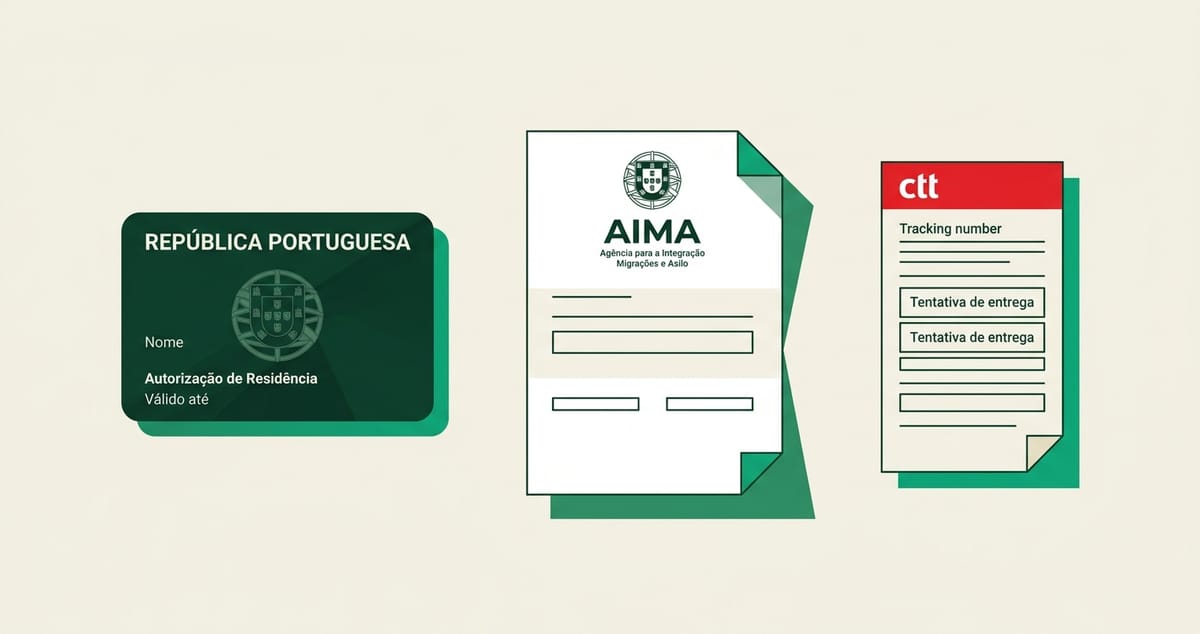
Your residence permit was approved. You have the email to prove it. What you don't have is the card. Nobody at AIMA is answering the phone to tell you when it arrives.
This is one of the most common situations facing people in Portugal right now. Approval and card delivery are two separate processes with two completely different timelines. The gap between them is where people get stuck: unable to travel, unsure of their legal status, and with no clear way to get answers.
This guide explains what is actually happening, what documents cover you while you wait, and what to do when the standard channels stop working.
Why does the card take so long after approval?
Most people assume approval means the card is coming in a few days. It doesn't. AIMA approves your application, then the file moves to a separate card production process, historically handled by INCM (the national print authority), and then CTT (Portugal's postal service) handles delivery. Each handoff adds time with no tracking visible to the applicant.
Real-world reported wait times in 2025 and 2026 average 4 to 12 weeks after approval, with some cases extending beyond 3 to 4 months. There is no published Service Level Agreement from AIMA or IRN for this step. No notification is sent between approval and card dispatch.
AIMA issued 386,000 residence permits in 2025 while managing a backlog of approximately 400,000 cases. The production and delivery pipeline has not kept pace with that volume.
What is the "Proof of Approval" and what does it actually cover?
In response to the backlog, AIMA introduced a digital "Proof of Approval", a declarative document with a QR code that confirms your application has been formally approved. It is issued online only, not at service desks. You access it through your AIMA online account.
It covers you in Portugal. Landlords, employers, and Portuguese authorities can scan the QR code to verify your status.
It does not cover you at international borders. The Proof of Approval is not a travel document. It cannot be used to cross into other Schengen countries. If you leave Portugal with only this document and your expired card, Schengen border guards in other countries are not bound by Portugal's interim measures and can turn you away.
This distinction matters more than AIMA's communications make clear. The document exists to reduce anxiety inside Portugal. It does not solve the travel problem.
Can you travel while waiting for the card?
Inside the Schengen area, travel carries real risk. Portugal's extension rules, which cover permits expired before June 30, 2025 through April 15, 2026, apply inside Portugal only. Foreign authorities are not bound by Portuguese decree law. A Schengen border guard in another country can legally reject someone entering with an expired card regardless of whether Portugal considers that card still valid.
Airlines can and do deny boarding to passengers presenting only an expired card with a renewal receipt. This is the risk most people do not anticipate. The problem does not start at the border, it starts at check-in. If travel is essential and cannot wait, consult a Portuguese consulate in your destination country before booking. They can issue a re-entry facilitation document or advise on whether travel is viable for your specific situation. Do not assume the combination of expired card and QR proof will be accepted by airline staff.
If your permit expired after June 30, 2025, you are covered by a standard 6-month grace period from your card's individual expiry date. Inside Portugal only.
What happens if CTT failed to deliver the card?
This is more common than AIMA's communications suggest. Cards are sent by registered post to the address on file. If delivery fails for any reason (wrong address registered, nobody home, building access issues), CTT returns the card to AIMA.
When this happens, AIMA sends an email to the address on your application with a specific date, time, and AIMA office location where you can collect the card in person. Check your spam folder. The notification goes to the email you registered when you applied, which may not be the one you currently use. Collecting a returned card in person carries a €28.50 fee under Portaria n.º 307/2023.
For applicants handled through the Mission Structure (Estrutura de Missão), the card is held at the Mission Structure office that managed your case and can only be collected with the official notice in hand.
If you have not received any email and the card has not arrived after 8 weeks post-approval, treat a CTT return as a likely scenario and start the contact process below.
How to contact AIMA when the phones don't work
Phone lines to AIMA are widely reported as congested or non-functional. The main contact number is +351 217 115 000, available Monday to Friday 08:00 to 20:00. In practice, high call volume means most people cannot get through. Complaints about contact difficulties account for 23% of all formal AIMA complaints logged in 2025.
The channels that are more likely to produce a result:
Email: [email protected]. Response times are slow but responses do come. Include your full name, NIF, date of birth, process number, and a clear description of the issue. Reference your approval date and the fact that the card has not been received. If your renewal was processed by IRN (Instituto dos Registos e do Notariado) rather than AIMA directly, use IRN's contact channels instead. The renewal letter you received will indicate which entity handled your case.
Contact form: contactenos.aima.gov.pt. Same information applies. The form creates a record of your contact, which matters if you escalate later.
Mission Structure offices in Lisbon, Porto, Coimbra, Braga, and Faro handle in-person queries. Some walk-in capacity exists but availability varies. Check the AIMA website for current hours before going.
When to file a formal complaint and how to do it
AIMA is legally required to issue a decision within 90 working days. If your case has exceeded this and is still marked "under analysis," you have grounds for a formal complaint that can push the case forward.
File through the national complaints platform at livroreclamacoes.pt. Select Public Services, find AIMA, and submit your complaint referencing the 90 working day deadline and your AIMA process number. You receive a complaint number immediately. This creates a formal paper trail that AIMA must respond to.
If the complaint does not produce a response or action within a reasonable period (typically 15 to 30 working days), escalate to the Provedor de Justiça (Ombudsman). The Ombudsman reviews complaints against public bodies and has the authority to formally request that AIMA respond to your case. This route is slower but it works when standard complaint channels have failed.
Some people have found success filing through the Livro Amarelo platform as an alternative, specifically referencing the 90-working-day legal deadline and requesting written confirmation of their application status. This approach has reportedly moved delayed applications within weeks in documented community cases.
What if you need the card urgently for work or banking?
The Proof of Approval document is the interim answer for employment and most banking situations inside Portugal. An employer can verify the QR code. A Portuguese bank can do the same. If an institution refuses to accept it, request that refusal in writing and escalate to AIMA with that documentation.
If you are facing a specific deadline (a job offer, a lease signing, a bank requirement), note the deadline clearly in your AIMA contact and formal complaint. Urgency with documented consequences is more likely to move a case than a general inquiry.
What not to do while waiting
Do not update your address with AIMA multiple times while a card is in transit. Each update can trigger a reissue or routing change that resets the delivery clock.
Do not assume the card will arrive at a previous address if you have moved since the application. Confirm your current address is on file before the card is sent.
Do not travel outside Portugal without checking your specific situation first. The extension rules and the Proof of Approval both have travel limitations that are not clearly communicated in AIMA's public materials.
Do not wait 6 months before contacting AIMA. Start the contact process at 8 weeks post-approval if the card has not arrived. The earlier you create a formal record, the more options you have if escalation becomes necessary.
The broader context: why this keeps happening
AIMA replaced SEF in 2023 and inherited a system already under pressure. By 2025, complaints filed against AIMA had doubled compared to the previous year, with 1,528 formal complaints logged between January and August 2025 alone. The most common categories: inadequate service (43%), scheduling and contact failures (23%), delays in documentation (14%).
AIMA has taken steps to reduce the backlog. The Mission Structure was created specifically for this purpose, the Proof of Approval document was introduced in 2025, and online tools have expanded. The backlog of approximately 400,000 cases means those measures are improving the system at the edges while the underlying volume remains high.
If you run a Portugal compliance diagnostic at app.worktugal.com, your residence permit status is one of the areas the tool checks, including whether your permit is current, expired, or pending renewal. It takes about 5 minutes and tells you where your exposure actually sits.
Frequently asked questions
How long does AIMA take to send the residence card after approval?
There is no official SLA. Real-world reported wait times in 2025 and 2026 average 4 to 12 weeks, with some cases beyond 3 to 4 months. No notification is sent between approval and dispatch.
What is the AIMA Proof of Approval?
A digital document with a QR code confirming your application was formally approved. Available through your AIMA online account. Valid for use inside Portugal with landlords, employers, and authorities. It is not a travel document.
Can I travel to Schengen countries while waiting for my residence card?
No. The Proof of Approval is not recognised at international borders. Airlines can deny boarding and Schengen border guards in other countries are not bound by Portugal's extension rules. Wait for the physical card, or consult a Portuguese consulate for a re-entry facilitation document if travel is essential.
What happens if CTT failed to deliver my card?
CTT returns the card to AIMA. AIMA sends an email with a date, time, and office for in-person collection. Collecting a returned card costs €28.50 under Portaria n.º 307/2023. Check spam. The notification goes to the email you used when you first applied, not necessarily your current one.
How do I contact AIMA when the phone doesn't answer?
Email [email protected] with your full name, NIF, date of birth, process number, and a description of the issue. The contact form at contactenos.aima.gov.pt creates a formal record. Mission Structure offices in Lisbon, Porto, Coimbra, Braga, and Faro also handle in-person queries.
What documents cover my legal status while waiting for the card?
The Proof of Approval from your AIMA account, carried with your expired card, covers you inside Portugal. Permits expired before 30 June 2025 are extended to 15 April 2026. Permits expiring from 1 July 2025 onward have a 6-month grace period from individual expiry. Inside Portugal only.
How do I file a formal complaint about AIMA card delay?
File through livroreclamacoes.pt. Select Public Services, find AIMA, and reference your process number and the 90 working day legal deadline. If AIMA does not respond in 15 to 30 working days, escalate to the Provedor de Justiça.
When should I start chasing AIMA about my card?
At 8 weeks post-approval if the card has not arrived. Do not wait 6 months. The earlier you create a formal record, the more escalation options you have.
Can my employer accept the Proof of Approval instead of the residence card?
Yes. The QR code can be scanned by employers and Portuguese banks. If a specific institution refuses, request the refusal in writing and include it in your AIMA complaint.
Does updating my address with AIMA reset the card delivery clock?
Potentially yes. Multiple address updates while a card is in transit can trigger a reissue or routing change. Confirm your correct address is on file once, then leave it.
Summary: what to do if your card has not arrived after approval
Get the Proof of Approval from your AIMA online account. It covers you in Portugal while you wait.
Check your email including spam for a CTT return notification. If the card was undeliverable, AIMA has it and will email you a collection date.
Do not travel internationally without checking your specific situation and, if necessary, getting a return visa from AIMA first.
If 8 weeks have passed since approval, email [email protected] with your full details and a clear description of the situation.
If you are past 90 working days and the case is still open, file a formal complaint at livroreclamacoes.pt referencing the legal deadline.
If formal complaints produce no response, escalate to the Provedor de Justiça.
The system is slow. It is not broken in a way that makes the card impossible to receive. Most people do get it. The problem is the complete absence of information between approval and delivery. That gap is what this guide is for.
Article updates
This article is updated as AIMA processes, timelines, and escalation paths change. Portuguese immigration rules shift frequently. What was true in 2024 may not be the current procedure.
27 March 2026 (v1.0). First published. Based on verified community reports, AIMA official communications, and law firm guidance current as of Q1 2026. Decree-Law extension to April 15, 2026 confirmed via official sources.