EU citizen in Portugal: the compliance checklist nobody gives you
EU citizens in Portugal still need CRUE, NISS, SNS, and IRS registration. Free movement covers none of it. The complete checklist in the correct order.

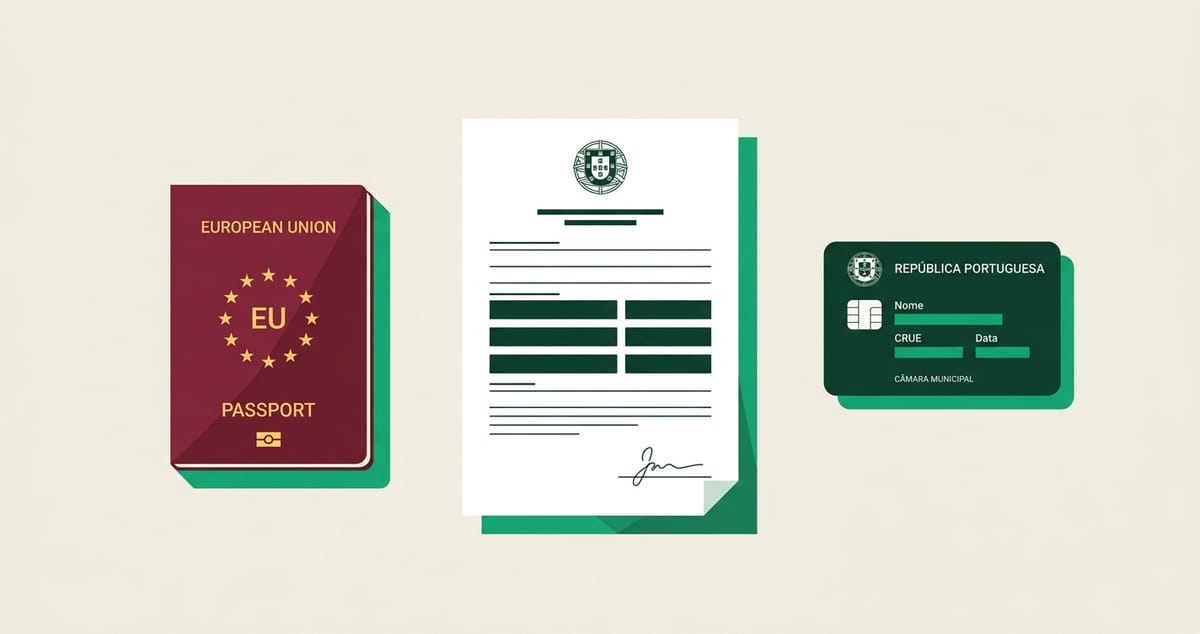
You have an EU passport. You do not need a visa. You do not need a work permit. You can live, work, and stay in Portugal as long as you want.
None of that means you are registered.
Most EU citizens arrive in Portugal and assume free movement handles the administrative side. It does not. Free movement gives you the legal right to be here. It does not file your NISS, register you with the social security system, connect you to public healthcare, or put you in the tax system. Those are four separate registrations, in a specific order, with specific deadlines.
The gap between "I can legally be here" and "I am correctly set up here" is where most EU citizens sit for months, sometimes years. Based on 883 Worktugal compliance diagnostic completions, EU citizens are one of the most common groups with NISS missing, not because they ignored it, but because they assumed their status protected them.
It does not. Here is what the checklist actually looks like.
The order matters
Each step depends on the one before it. Do them out of sequence and you waste time going back.
Step 1: NIF at Finanças, first and immediately.
Step 2: CRUE at your Câmara Municipal, within 30 days after the 90-day mark. Not AIMA.
Step 3: NISS at Segurança Social. Requires your CRUE.
Step 4: SNS Número de Utente at your local Centro de Saúde.
Step 5: IRS filing and tax residency. Declare from day one.
Step 6: IFICI application if you qualify. Deadline is January 15 of the year after you establish tax residency. This one cannot be undone if missed.
Step 7: Social security — A1 certificate if employed by a foreign EU employer.
Step 1: NIF
Get this before you find a flat, before you open a bank account, before you sign anything. Everything else requires it.
Your NIF is your Portuguese tax identification number, issued by AT (Autoridade Tributária, known as Finanças). It is required for every financial transaction in Portugal: banking, leases, utilities, employment, property.
As an EU citizen, you do not need a fiscal representative. Non-EU non-residents must appoint a Portuguese resident as a fiscal intermediary, which costs €100 to €300 per year. You do not. This is one of the clearest practical advantages of EU status in Portugal.
Go in person to your nearest Finanças office. Bring your EU national ID card or passport. If you have a Portuguese address, bring proof of it. If you are applying before finding permanent accommodation, bring your passport and the address of where you are staying temporarily. NIF is typically issued on the same day.
Step 2: CRUE at your Câmara Municipal, not AIMA
This is where most EU citizens lose days and sometimes weeks.
CRUE stands for Certificado de Registo de Cidadão da União Europeia. It is your official residency registration certificate. You can apply for CRUE before your first 90 days are up. There is no reason to wait. Getting it done in your first few weeks unblocks NISS sooner and removes a sequencing dependency that slows everything downstream. After 90 days of residence, you have 30 days to apply, meaning by approximately day 120 you are legally required to have filed.
The most common mistake is going to AIMA. AIMA (Agência para a Integração, Migrações e Asilo) was created to handle non-EU nationals when SEF was dissolved in October 2023. If you show up at AIMA for a CRUE as an EU citizen, you will be redirected. The appointment is wasted.
EU citizens register for CRUE at their Câmara Municipal, meaning city hall or town hall. Some Lojas do Cidadão in larger cities also handle it. There are 12 specific Loja do Cidadão locations across Portugal set up for foreigners where you can request NIF, NISS, and SNS numbers together in a single visit. To find the current list, go to gov.pt and search for "como e onde pedir", then open that heading. Call your local Câmara before going to confirm whether they issue on-site or require an appointment via the SIGA platform at siga.marcacaodeatendimento.pt.
What to bring:
Your valid EU national ID card or passport, plus a copy. Proof of Portuguese address: a rental contract, property deed, or utility bill in your name. If the lease is not in your name, you may need an Atestado de Residência from your Junta de Freguesia, the local parish office. Your NIF is advisable to bring even if not always formally listed as required. Proof of your situation: an employment contract if you are employed, self-employment registration documents if you are self-employed, bank statements showing sufficient funds if you are self-sufficient (approximately €870 per month, based on the 2025 Portuguese minimum wage), or enrollment confirmation if you are a student. The fee is €15 to €16, paid at the treasury desk or Multibanco terminal.
Processing time varies. Some câmaras issue the certificate immediately. Others take up to a month. Do not schedule your NISS appointment around a same-day CRUE.
The fine for not registering after the 90-day mark is €400 to €1,500. If you apply after month 12 of residence, you must pay a fine directly to AIMA before the CRUE can be processed.
One thing many EU residents don't know: free movement is unconditional only for the first 3 months. After that, Article 7 of EU Directive 2004/38 requires you to show that you are employed, self-employed, studying, or have sufficient financial resources to support yourself without relying on the Portuguese social system. In practice it is rarely enforced at the border, but it is the legal framework your CRUE application sits within. The proof of situation documents listed above are not a formality. They are the evidence that your continued residence is legally grounded.
A note on digital authentication: CMD (Chave Móvel Digital), Portugal's digital government authentication system, is built around the Portuguese cartão cidadão number format. EU citizen IDs from other countries don't match that format, so CMD registration fails for many EU residents even after completing CRUE. This blocks access to any online portal requiring CMD authentication, including parts of Segurança Social and Portal das Finanças. There is no workaround short of obtaining a Portuguese-registered document. Going in person is usually the only path forward when CMD is required.
Related gap: many Portuguese administrative systems require a cartão cidadão number as a mandatory field. EU residents in their first 5 years hold CRUE, not a cartão cidadão. You can comply with every registration requirement and still be unable to complete certain processes because the system was built for Portuguese nationals. If you hit a field that requires a CC format and rejects your EU ID, there is often no digital path forward.
After 5 continuous years of legal residence, you become eligible for Permanent Residency, which is a separate certificate costing €15 and valid for 10 years.
Step 3: NISS
Free movement does not register you for Portuguese social security. You register yourself.
Your NISS (Número de Identificação da Segurança Social) is your social security identifier. Since late 2023, NISS applications require your CRUE as a supporting document. Apply before you have CRUE and the application will be rejected or stalled.
You can apply online via the Segurança Social portal at seg-social.pt, or in person at a Segurança Social office. Bring your EU ID or passport, your CRUE, and proof of your employment situation.
If you work for a Portuguese employer, they typically register you as part of onboarding. Verify it has happened. Do not assume.
If you are employed by a foreign EU company and work remotely from Portugal, the same registration loop that blocks non-EU workers also applies to you. The online portal requires a Portuguese employment contract. Foreign employment contracts, regardless of which EU country the employer is in, get rejected at document validation.
Being an EU citizen removes the visa requirement. It does not remove the employment contract requirement in the portal. If you hit the loop, the exits are the same as for non-EU workers: register as self-employed first through Finanças, use an Employer of Record with a Portuguese employment relationship, or work with an immigration lawyer who knows the manual escalation process inside Segurança Social.
The full breakdown of the registration loop, all three exits, and what foreign-employed workers actually go through is covered in detail in our NISS guide for Portugal. The EU citizen path and the non-EU path converge at this exact point.
If you want to go the Employer of Record route, Deel covers Portugal and handles the full employment setup including NISS registration. Through 31 March 2026, new signups via this link are eligible for up to $1,500 in Deel Credit. Get started with Deel →
Disclosure: this is an affiliate link. Worktugal earns a commission if you sign up. We only recommend tools that solve the specific problem described above.
Check your Portugal compliance score →
Step 4: SNS Número de Utente
Your EHIC card covers medically necessary treatment during short-term stays in Portugal. It does not register you as a resident in the Portuguese health system.
To access the SNS (Serviço Nacional de Saúde) as a long-term resident, you need a Número de Utente. This is the health service user number, separate from your NISS, issued by the health system rather than the social security system.
Go to your nearest Centro de Saúde, which must be the one serving your registered address. The SNS uses a geographic assignment system. Bring your EU ID, CRUE, NIF, proof of address, and NISS if you have it. The number is assigned at the centre or sent shortly after.
Once registered, you can access general practitioners, specialist referrals, and standard emergency care as a resident. Co-payments apply for most services.
If you move address, update your registration at the Centro de Saúde covering your new area. You cannot use a health centre outside your geographic catchment for standard appointments.
Step 5: Tax residency and IRS
You become a Portuguese tax resident if you spend more than 183 days in Portugal in any 12-month period, consecutive or not. You also become tax resident if you maintain a habitual residence here with intent to use it as your primary home, regardless of days spent.
The clock starts on arrival. There is no grace period and no opt-out based on EU citizenship.
As a tax resident, you must declare your worldwide income to Portuguese tax authorities. You do this by filing Modelo 3 via the Portal das Finanças at portaldasfinancas.gov.pt. The filing window is April 1 to June 30 of the year following the tax year. Income earned in 2025 is declared between April 1 and June 30, 2026. Missing the deadline triggers fines and interest on taxes owed.
If you have income from other EU countries, double taxation treaties determine where you pay. Most employment income is taxed where the work is physically performed. If you live and work in Portugal for a foreign employer with no valid A1 certificate covering you, Portugal asserts the right to tax that income even if your employer is remitting taxes in another country.
Step 6: IFICI — NHR is gone
If you moved to Portugal expecting to benefit from the Non-Habitual Residency tax regime, that option ended on January 1, 2024.
NHR was replaced by IFICI (Incentivo Fiscal para Investigação Científica e Inovação), often called NHR 2.0. It is narrower. Eligibility requires your job role to match specific occupational categories listed in Annex I of Ordinance 352/2024/1, defined by CPP occupation codes. Having a degree and working broadly in technology or science is not automatically sufficient. The role must match the listed professions.
Three differences from old NHR that matter most:
Employment and self-employment income from qualifying activities: 20% flat rate, the same as before. This part did not change.
Pension income: no longer protected. Under old NHR, pensions were taxed at a flat 10%. Under IFICI, pensions are taxed at standard Portuguese IRS rates, which can reach 48% or higher depending on income. If you moved to Portugal specifically to retire under NHR protection, IFICI does not offer that benefit.
Capital gains on financial assets and dividends from non-blacklisted countries: 0%, unchanged from before.
The application deadline for IFICI is January 15 of the year after you establish tax residency in Portugal. If you became tax resident in 2025, the deadline is January 15, 2026. This deadline is strict, it is enforced, and IFICI can only be used once per taxpayer. Missing it means the option is permanently gone.
If you are unsure whether your role qualifies, an hour with a Portuguese tax advisor before the deadline costs less than losing a decade of tax protection.
Step 7: Social security and the A1 certificate
If you are employed by a Portuguese employer or self-employed in Portugal, you contribute to the Portuguese social security system.
Employee contribution rate: 11% of gross salary. Employer rate: 23.75% (standard). Self-employed rate: 21.4% of relevant income. For service providers, relevant income is calculated as 70% of total income, making the effective rate approximately 15% of total earnings. There is a 12-month exemption from contributions when you first register self-employment activity at Finanças.
If you are employed by a foreign EU employer and living in Portugal, a cross-border telework framework has been in force since July 2023 under EU Regulation 883/2004. If you work from Portugal less than 50% of your working time, your employer can apply for a continued exemption keeping you in the home country social security system. If you work from Portugal 50% or more of the time, Portuguese social security rules typically apply.
An A1 certificate issued by your home country's social security authority confirms you remain in that system during a temporary posting, up to 24 months. Without a valid A1, and working full-time from Portugal for a foreign employer, you are likely subject to Portuguese social security contributions from the point you established residency. Most foreign employers have never heard of the A1 certificate. Most never apply. The exposure sits with the worker.
What EU citizenship actually covers in Portugal
It covers the right to enter, reside, and work without a visa or work permit. That is significant.
It does not cover CRUE registration, NIF, NISS, SNS access, IRS filing, IFICI eligibility, or social security contributions. Each of those is a separate registration with its own requirements, timeline, and penalties. EU status simplifies a few of them (no fiscal representative, no work visa required) but it does not eliminate any of them.
The assumption that the passport handles the setup is the single most consistent pattern across EU citizens in the diagnostic data. It is not a documentation gap. It is a mental model gap. The rights and the registrations are two different things.
Run the Worktugal compliance diagnostic to see your full setup score →
Frequently asked questions
Where do EU citizens register for CRUE in Portugal?
At your Câmara Municipal (city or town hall), not at AIMA. AIMA handles non-EU nationals. Some Lojas do Cidadão in larger cities also process CRUE. Call ahead to confirm whether an appointment is required.
What is the deadline for CRUE after arriving in Portugal?
You must apply within 30 days after your first 90 days of residence, so approximately by day 120. The fine for not registering is €400 to €1,500. If you apply after 12 months, you must pay a fine to AIMA before your application can proceed.
Do I need CRUE before I can get a NISS?
Yes, since late 2023. Segurança Social requires CRUE as a supporting document for NISS applications. Get your CRUE first, then apply for NISS.
Does my EHIC card cover me as a Portuguese resident?
No. EHIC covers medically necessary treatment for short-term stays. As a long-term resident, you need to register for a Número de Utente at your local Centro de Saúde to access the SNS properly.
Is NHR still available for EU citizens moving to Portugal?
No. NHR ended January 1, 2024. It was replaced by IFICI (NHR 2.0), which has narrower eligibility criteria and no longer protects pension income. The application deadline for IFICI is January 15 of the year after you establish tax residency. It can only be used once.
Do I need a fiscal representative as an EU citizen?
No. Non-EU non-residents must appoint a fiscal representative for their NIF. EU and EEA citizens are exempt from this requirement and can register for NIF directly at Finanças.
What happens if I work remotely for a non-Portuguese EU employer from Portugal?
If you work full-time from Portugal without a valid A1 certificate from your employer's home country, Portugal will likely assert social security contributions from the point you established residency. The cross-border telework framework (July 2023) provides some protection if you spend less than 50% of your working time in Portugal, but requires your employer to apply. Most employers never do.
Can I still get NISS as an EU citizen if I work for a foreign company?
Technically yes, but in practice you may hit the same registration loop as non-EU workers: the online portal requires a Portuguese employment contract and rejects foreign ones. Your exits are the same: register as self-employed first, use an Employer of Record, or work with a lawyer who knows the manual escalation process.
If I missed the 90-day CRUE deadline, can I leave Portugal and re-enter to reset the clock?
No. Within Schengen there are no border stamps between member states, so leaving and returning does not reset any deadline. More importantly, the exposure does not come from someone tracking your entry date. It comes from your own paper trail: lease start date, bank account opening, NIF registration, NISS application. Those carry timestamps that determine your status when you apply for CRUE or file IRS. Leaving and returning does not change what those documents say.
Does this checklist apply to citizens of Norway, Iceland, Liechtenstein, or Switzerland?
Norway, Iceland, and Liechtenstein are EEA countries and hold the same free movement rights as EU citizens under the EEA Agreement. Portugal treats them essentially the same for CRUE registration and NISS purposes. Switzerland has a separate bilateral agreement with the EU that gives similar but not identical rights. Swiss citizens generally follow the same registration sequence, but it is worth checking AIMA's current guidance for Swiss nationals as the bilateral agreement has some different terms. The NIF fiscal representative exemption also applies to EEA citizens.
Article updates
Portugal's administrative requirements for EU citizens change without much notice. Offices change their processes, thresholds shift, and what worked in 2023 may not work in 2025. This article is updated when readers flag errors or official sources change.
27 March 2026 (v1.1) — Updated from reader comments and field reports on r/PortugalExpats. Added: CRUE can be done before day 90 (hmijail field confirmation); 12 specific Loja do Cidadão locations for combined NIF+NISS+SNS requests; conditional rights after 3 months under Article 7 EU Directive 2004/38; CMD authentication gap for EU citizen IDs; cartão cidadão gap for CRUE-holders; leave/re-enter FAQ; EFTA/EEA/Switzerland note.
26 March 2026 (v1.0) — First published. Based on research against gov.pt, aima.gov.pt, seg-social.pt, EU Commission sources, and Worktugal diagnostic data from 883 completions.
Van Vo is the founder of Worktugal. He went through Portugal's compliance system as a foreign worker and built the diagnostic after nearly missing several of these requirements himself. The data referenced comes from 883 completed diagnostic assessments as of March 2026.