NISS in Portugal: what your employer won't tell you
NISS in Portugal explained clearly. What it is, who needs it, the exemption trap, and how to register yourself.

You got your NIF. You found a place to live. You set up your Portuguese bank account. You think the administrative side of moving to Portugal is handled.
For most foreign workers, it is not. The number actually missing from their setup is the NISS, and 50% of the 883 people who ran the Worktugal compliance diagnostic did not have one.
This is not a small oversight. NISS is your Portuguese social security number. Without it, you do not officially exist in the social security system. That means potential liability for backdated contributions if Segurança Social identifies the gap later, no unemployment protection, and no pension contributions building up.
The reason most people are missing it is simple: they assumed someone else had handled it.
What is NISS and why does it matter?
NISS stands for Número de Identificação da Segurança Social. It is your unique identifier in Portugal's social security system.
Your NIF (tax number) handles your relationship with the Portuguese tax authority. Your NISS handles your relationship with Segurança Social, the institution that manages contributions, benefits, and pensions.
The two are separate. Getting one does not give you the other.
If you are living and working in Portugal, as a freelancer, a remote worker employed abroad, or an employee of a Portuguese company, you need both.
NISS is linked to your access to the SNS (Serviço Nacional de Saúde), Portugal's national health service. To use the SNS you need a Número de Utente (health service user number), which is technically issued separately from NISS. In practice, many health centres require a NISS before they will issue your Utente number. The two are not the same thing, but getting one without the other is often blocked in practice. Since March 2025, there is a combined application that lets eligible residents request NIF, NISS, and SNS Utente number together in one step.
Social security contributions, whether you pay into the system or are temporarily covered by your home country, must be tracked under a NISS number. Unemployment, sickness benefits, and pension entitlements in Portugal all require a NISS. When you file your IRS (Portuguese income tax return), NISS and NIF must match. Discrepancies create administrative blocks.
Why doesn't your employer register you?
This is the core confusion, and it catches foreign-employed workers constantly.
If you work for a Portuguese company, your employer registers you with Segurança Social as part of onboarding. The NISS gets created automatically as part of that employment record.
If you work for a company based outside Portugal, a UK employer, a US company, a German firm, here is the technical reality: that foreign employer is legally required to register your employment relationship with Portuguese Social Security if you physically work in Portugal and are not covered by an A1 certificate. They can do this directly or appoint a Portuguese representative using a PA-12 authorisation form.
In practice, almost none of them do. They are unaware of the obligation, they have no Portuguese operations, and no one enforces it against them directly. The gap falls on you.
The assumption that your employer handles the social security side of things is reasonable in most countries. In Portugal, for foreign-employed workers, it is simply wrong.
You are the one responsible for registering. Not your employer. Not your accountant, unless you specifically instruct them. You.
The exemption trap that catches people
Some foreign workers have heard of an exemption period and interpreted it to mean they do not need to register at all for the first year or two. This misreading leaves people exposed.
The exemption that exists, under EU Regulation 883/2004, applies to posted workers. If you are sent to Portugal temporarily by your employer in another EU country, your employer can apply for an A1 certificate from your home country's social security authority. This certificate confirms you continue contributing to your home country's system during the posting period, so you do not pay into both systems at once.
This exemption covers contributions. It does not eliminate your need for a NISS number.
You still need to register with Segurança Social. You still need the number. The A1 certificate changes where your contributions go, it does not remove you from Portugal's administrative system.
Non-EU workers on digital nomad visas (D8), passive income visas (D7), or long-stay residency have no equivalent exemption to reference. They need NISS registration from the point they establish residence and begin working from Portugal.
People hear "exemption," delay registration, and when the period ends (if it applied at all), they realise they were never registered in the first place. The catch-up is manageable, but it typically involves backdated contribution assessments for the period you were unregistered. And for foreign-employed workers, the registration process itself has an additional obstacle: the online portal requires a Portuguese employment contract.
Who needs to register for NISS in Portugal?
Anyone who is resident in Portugal and working, in any capacity, needs a NISS.
Remote workers employed by foreign companies: if Portugal is where you live and work, Portugal's social security system applies to you regardless of where your employer is based.
Freelancers and self-employed workers (recibos verdes): if you issue invoices under Portuguese law, you must register as a trabalhador independente with Segurança Social. NISS is required for this registration.
Employees of Portuguese companies: your employer handles this, but verify it has been done. Do not assume.
Non-working residents present long-term may still need NISS to access SNS as a standard resident. Family members of registered workers often need their own registration rather than being covered under the primary holder.
How to register for NISS in Portugal
The path depends on your situation. For employees of Portuguese companies, your employer handles registration. Everyone else needs to go direct. Here is what each path actually looks like.
Online via Segurança Social Direta
If you already have a NIF and a Portuguese phone number, you can register at segurancasocial.pt. Since 2024, the online portal is available in English with clearer guidance on required documents. You submit your NISS request and upload supporting documents directly through the portal.
Documents typically required: valid passport or national ID card, NIF, proof of Portuguese address (lease agreement, utility bill, or NHR/IFICI registration confirmation), and if employed, a copy of your employment contract or a letter from your employer confirming your work arrangement.
The online process typically takes 2 to 6 weeks. You will receive your NISS by post or via the portal once processed.
Important for foreign-employed workers: the online portal's document validation requires a Portuguese employment contract. If you are employed by a foreign company and submit a UK, US, or other non-Portuguese contract, the system will reject your application. This is not a temporary bug. It is how the portal is built. Do not spend months resubmitting the same documents expecting a different result.
The registration loop for foreign-employed workers
If you work remotely for a foreign employer and do not have a Portuguese employment contract, you will likely run into the following loop:
You try to register online. The portal rejects your foreign employment contract. You go to a Segurança Social office. The office turns you away at the door and tells you to apply online. You go back online. The portal rejects your contract again.
This is not a misunderstanding. Offices in Portugal have largely stopped accepting NISS applications in person. They have staff outside redirecting people to the online system. The online system rejects foreign contracts. There is no escalation button.
There are three paths out of this loop:
Option 1: Register as self-employed first. Open an atividade as a trabalhador independente with Finanças (the tax authority). Once you are registered as self-employed in Portugal, you can register with Segurança Social as a trabalhador independente. This bypasses the employment contract requirement. The trade-off is that you move from employment to contractor status, which changes your tax and contribution obligations. This works well for people who are already running their own client base or are willing to restructure their work arrangement.
Option 2: Use an Employer of Record (EoR). An EoR is a Portuguese-registered company that formally employs you on behalf of your foreign employer. Because the EoR is a Portuguese entity, they handle NISS registration as part of onboarding. Your NISS is issued through that employment relationship. This is the cleanest path for people who want to stay as an employee. It costs more (EoR fees are typically €200 to €500 per month), but it resolves the registration problem completely and keeps your employment structure intact.
Deel covers Portugal and handles the full EoR setup including NISS registration. Through 31 March 2026, new signups via the referral link below are eligible for up to $1,500 in Deel Credit. Get started with Deel →
Disclosure: this is an affiliate link. Worktugal earns a commission if you sign up. We only recommend tools that solve the specific problem described above.
Option 3: Get an immigration lawyer who knows the manual route. Some lawyers know the specific internal escalation process within Segurança Social that bypasses the standard online system. This is not widely advertised and depends on finding someone with direct experience of this process, not just general immigration knowledge. If the first two options do not fit your situation, this is worth pursuing.
The Loja do Cidadão shortcut
If you already have your residence card with a Portuguese address on it, there is a faster path. You can go to a Loja do Cidadão and request your NIF, NISS, and SNS Utente number in a single visit. This bypasses the online portal entirely.
The catch: it only works if your residence card already shows a Portuguese address. If you are still mid-process, waiting for your card, or your card does not yet reflect your current address, this route is not available to you yet. Full details on gov.pt.
For freelancers specifically
If you are registering as self-employed (opening atividade at Finanças), you will need your NISS as part of that process. Once registered as self-employed, you must contribute 21.4% of your taxable base to Segurança Social. The taxable base is calculated as 70% of your invoiced services income.
There is a 12-month grace period before contributions begin for newly self-employed workers. Technically, the obligation starts on the first day of the 12th month following the month you registered activity. You register first. Contributions begin after the grace period.
Once contributions start, you must submit a quarterly income declaration to Segurança Social. Missing this declaration is a formal offense with a fine of €50 to €250 per missed filing. It is separate from not paying contributions, even if you earned nothing, the declaration is required.
What happens if you have not registered
The immediate practical consequences: no SNS access without private insurance, no formal presence in the social security system, and potential issues when filing your annual IRS return.
The longer-term risk: if Segurança Social identifies that you were working in Portugal without being registered, backdated contributions may be assessed from the point your residency and work activity began. The calculation is based on your actual income during that period.
This becomes relevant when people apply for longer-term residency permits, apply for benefits, or when tax filings are cross-checked against social security records. It is not a theoretical risk, it is a standard audit outcome for people who registered late.
The liability does not sit only with the worker. If a foreign company employs people based in Portugal and has not registered them with Segurança Social, the employer can also be assessed backdated contributions for the period of non-registration. Most foreign companies with remote workers in Portugal are unaware this obligation exists. When it surfaces, it typically comes through a tax inspection of the worker, or when the worker applies for benefits.
The cost of registering now is administrative time. The cost of registering late is potentially financial.
The data behind this gap
I built the Worktugal compliance diagnostic because I went through Portugal's system myself and found the gaps that no guide explained clearly. Since launching, 883 people have completed the full diagnostic.
50% of them did not have a NISS registered.
This is the single most common gap across all user types, more common than missing AIMA appointments, more common than undeclared tax residency, more common than unregistered freelance activity.
The pattern is consistent across every user segment: employed abroad, EU citizen, freelancer. The assumption that someone else handles it is near-universal. No one handles it. You do.
If you are not certain your NISS is registered and active, check now. Do not wait until you need the SNS, until you are filing taxes, or until you are renewing your residency permit.
Check your Portugal setup score →
What changed in December 2025
Portuguese law updated the deadline for employers to report new hires to Social Security. The communication must now be completed by the start of the employment contract, not the day before as previously required. If you are being hired by a Portuguese company or a foreign employer who is properly registered here, they are now required to notify Segurança Social before your first day of work, not after.
For foreign-employed workers registering themselves, this change does not affect the self-registration process. It matters if you are relying on a Portuguese employer or representative to handle registration on your behalf.
Frequently asked questions
Can I get NISS before I have a NIF?
No. NIF comes first. You need a valid NIF to register for NISS. If you do not have a NIF yet, that is step one.
Do EU citizens need NISS?
Yes. EU free movement covers your right to live and work in Portugal without a visa. It does not cover your social security registration. EU citizens need NISS exactly as non-EU citizens do.
If you are an EU citizen, NISS is one item on a longer checklist. See the full EU citizen compliance checklist for Portugal.
Does my NISS number appear on any document?
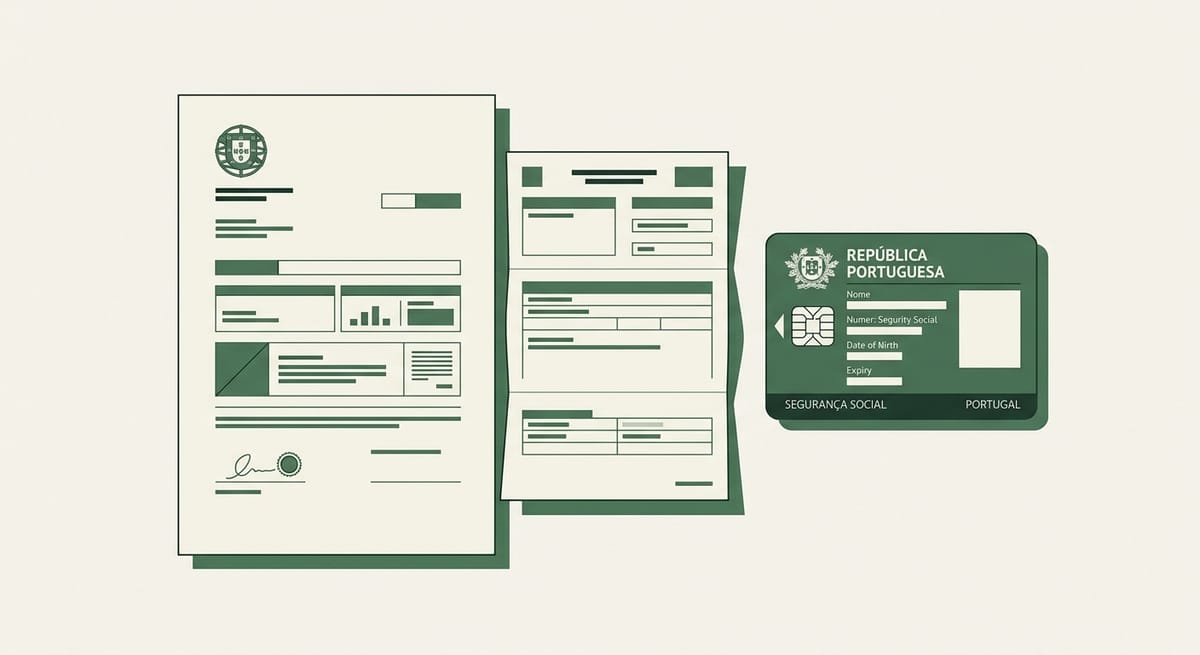
Yes. Once registered, you will receive a Cartão de Identificação da Segurança Social card. Your NISS number also appears on your health centre registration and on salary documents from Portuguese employers.
What if I already have private health insurance, do I still need NISS?
Yes. NISS is not about health insurance. It is your social security identifier. Private health insurance does not replace or remove the requirement.
Can I register NISS myself or do I need an accountant?
You can register yourself via the online portal. An accountant (contabilista certificado) is useful if your employment situation is complex, for example, if you are foreign-employed and unsure whether an A1 certificate applies to you, but the standard registration is a direct process between you and Segurança Social.
I have been in Portugal for over a year and never registered. What do I do?
Register now. The process is the same. Segurança Social will assess your situation based on when you began residing and working in Portugal. An accountant can help you understand any contribution liability for the period you were unregistered before you go in.
The online portal rejected my employment contract. What do I do?
If you have a foreign employment contract, the online portal will reject it. It only accepts Portuguese employment contracts. Your options are: register as self-employed (trabalhador independente) through Finanças first, use an Employer of Record to get a Portuguese employment contract, or go through the Loja do Cidadão combined application if you already have a residence card with your Portuguese address on it.
Can I go in person to a Segurança Social office?
Most offices are now turning away walk-in NISS applications and redirecting people to the online portal. Some offices in larger cities have more flexibility, but you should not rely on this. The Loja do Cidadão combined application (NIF+NISS+SNS in one visit) is the better in-person option if you have your residence card ready.
Article updates
Portugal's social security rules are opaque and change without much notice. This article is updated when readers flag errors or new information surfaces. If something here is wrong or out of date, the history below shows what was changed and why.
26 March 2026 (v1.4) — Added the Loja do Cidadão combined path (NIF+NISS+SNS in one visit, requires residence card with Portuguese address). Added two new FAQs on portal rejection and in-person options. Source: reader comment by u/flarex with gov.pt confirmation link.
25 March 2026 (v1.1–1.3) — Corrected the "go in person" recommendation: offices are now turning NISS applicants away at the door and redirecting to the online portal. Added the registration loop section for foreign-employed workers, naming the problem honestly and the three paths out (self-employed registration, Employer of Record, immigration lawyer). Added employer liability note (foreign companies can be assessed backdated contributions, not just workers). Corrected the NISS/SNS relationship (SNS uses a Número de Utente, technically separate from NISS, but often blocked without one in practice). Added the March 2025 combined NIF+NISS+SNS application option. Sources: reader comments on r/PortugalExpats, gov.pt, Prismaat announcement.
24 March 2026 (v1.0) — First published. Based on data from 883 Worktugal diagnostic completions.
Van Vo is the founder of Worktugal. He went through Portugal's compliance system as a foreign worker and built the diagnostic after nearly missing several of these requirements himself. The data referenced comes from 883 completed diagnostic assessments as of March 2026.