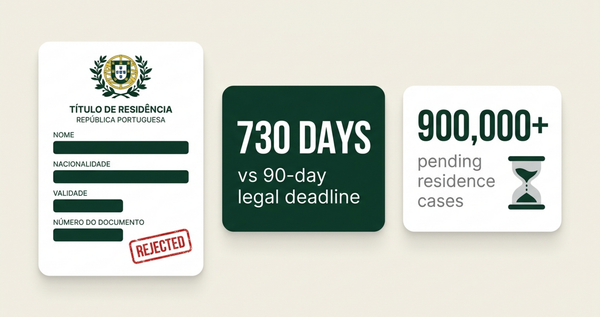
Portugal's 2026 citizenship law: stop the panic. Here are the facts.
Parliament approved a major change to the citizenship law. Here is what actually changed and who it protects.

Update May 3, 2026: President Seguro signed this into law. Read what actually changed →
Everyone is panicking right now. If you look at Reddit or Facebook, you might think you need to pack your bags and leave Portugal tomorrow.
Take a deep breath.
Yes, Parliament approved a major change to the Nationality Law on April 1, 2026. But a lot of what you are reading online is wrong. To understand this, you need to know the difference between Residency (your right to live here) and Citizenship (your right to a passport).
The new law makes getting a passport much harder. Your right to live in Portugal has not changed.
Here is the simple truth about what is happening, what isn't, and what you should do now.
What actually changed?
If this law takes effect, the path to a Portuguese passport gets longer and stricter:
- The 10-year wait: The old 5-year timeline for citizenship is gone. Most people will now wait 10 years. If you are from an EU country or a CPLP country (Brazil, Angola, Mozambique, Cape Verde, Guinea-Bissau, São Tomé and Príncipe, Timor-Leste, or Equatorial Guinea), you wait 7 years.
- The clock resets: Before, the time you spent waiting for your residence permit often counted toward citizenship. Not anymore. The clock now starts from the date your first residence card was issued. If AIMA took two years to give you a card, those two years no longer count toward your passport.
- Babies born in Portugal: Automatic citizenship at birth for children of foreign parents is ending. Under the new rules, the child needs 5 years of legal residency before they can apply for a Portuguese passport. Parents also can no longer use "I have a child born here" as a shortcut to citizenship.
- New tests: You still need the A2 Portuguese language test. There is now also a civic knowledge test covering Portuguese history and culture, plus a formal declaration that you support democratic values.
What did NOT change?
Your residency is safe. This is the part most people are missing.
- Permanent residency (PR) is still at 5 years. After 5 years of legal residence, you can still apply for Permanent Residency. PR locks in your right to live and work in Portugal indefinitely. You just have to wait longer for the actual passport.
- Your current permit is safe: Your D7, D8, Golden Visa, or any other residency permit remains valid and renewable exactly as before.
- Schengen travel: Your right to travel within the Schengen area on your residency card is unchanged.
The grandfathering trap
This is why people are upset. Parliament specifically rejected "grandfathering" rules, meaning no transitional protections for current residents.
What this means in practice: If you have lived in Portugal for 4 years and the law takes effect, you are suddenly pushed onto the 10-year clock. Those 4 years still count, but you now need 6 more instead of 1.
The only protection: If you submit a complete citizenship application before the new law officially enters into force, your application is assessed under the old 5-year rule. Once it is filed, you are protected.
Is it law yet?
No. As of early April 2026, this is a bill, not a law.
The bill passed Parliament on April 1, 2026. It is now on President António José Seguro's desk. He has 20 days to choose:
- Sign it: It becomes law immediately.
- Veto it: He sends it back to Parliament, unlikely to stop it given the two-thirds majority.
- Send to Constitutional Court: Adds roughly 25 days while the Court reviews it. A previous version of this law was blocked by the Court in December 2025, so this is a real possibility.
The earliest realistic date for this to become law is May 2026.
What you should do right now
- Find your first residence card. Look at the issue date. That is your new Day Zero under the new law.
- If you are close to 5 years: Talk to a Portuguese immigration lawyer immediately. If your card issue date is within reach of 5 years, you may still be able to file under the old rules before the President signs.
- If you are years away from 5: Focus on Permanent Residency at the 5-year mark. It gives you the same right to stay, without the passport. Get your compliance clean now, because the new clock runs twice as long.
Frequently asked questions
Does the new law cancel my residency permit?
No. Residency permits (D7, D8, Golden Visa, TRC) are completely unaffected. You can still live, work, and renew your permit as before.
I have lived in Portugal for 4 years. Do I now need 10 years for citizenship?
If you haven't filed a citizenship application yet and the law takes effect, yes, you would need to complete 10 years total (or 7 if you are EU/CPLP). Your 4 years still count. You just need more years on top.
My citizenship application is already submitted. Am I protected?
Yes. Applications submitted before the law enters into force are processed under the old 5-year rule.
Can I still get permanent residency after 5 years?
Yes. Permanent residency remains at 5 years and is unchanged by this law. PR gives you the same right to live in Portugal long-term. You just have to wait longer for the passport.
When does my citizenship clock actually start now?
From the date your first Portuguese residence card was issued, not the date you applied, and not the date you arrived.
What CPLP countries get the 7-year timeline?
Brazil, Angola, Mozambique, Cape Verde, Guinea-Bissau, São Tomé and Príncipe, Timor-Leste, and Equatorial Guinea.
What about children born in Portugal to foreign parents?
Automatic citizenship at birth is ending. The child will need 5 years of legal residency before applying. Parents cannot use a child born in Portugal as a citizenship route anymore.
Is this law definitely going to pass?
The previous version was blocked by the Constitutional Court in December 2025. President Seguro could send this version to the Court again. Nothing is certain yet.
When will this law actually take effect?
Not before May 2026 at the earliest. It depends on whether the President signs or sends it for review. Watch the Diário da República for the official publication date.
Does this change your compliance timeline?
The new clock runs for 7 or 10 years. A single compliance gap can now cost you years, not weeks: a missed Social Security payment, a wrong address on your NIF, a delayed AIMA renewal.
This article reflects the situation as of early April 2026, based on the parliamentary vote of April 1, 2026. The law is not yet in force. This is for educational purposes only and does not constitute legal advice. Always consult a certified Portuguese immigration lawyer for your specific case.
Worktugal is free: EU tech jobs scored for AI risk, and honest relocation help from someone who has actually done it. Sign up free.
Not sure where your own setup stands? Check your own setup - free, 5 minutes.
Looking for EU tech jobs with AI risk scores? Browse free.