AIMA took two years to decide. That delay got him deported.
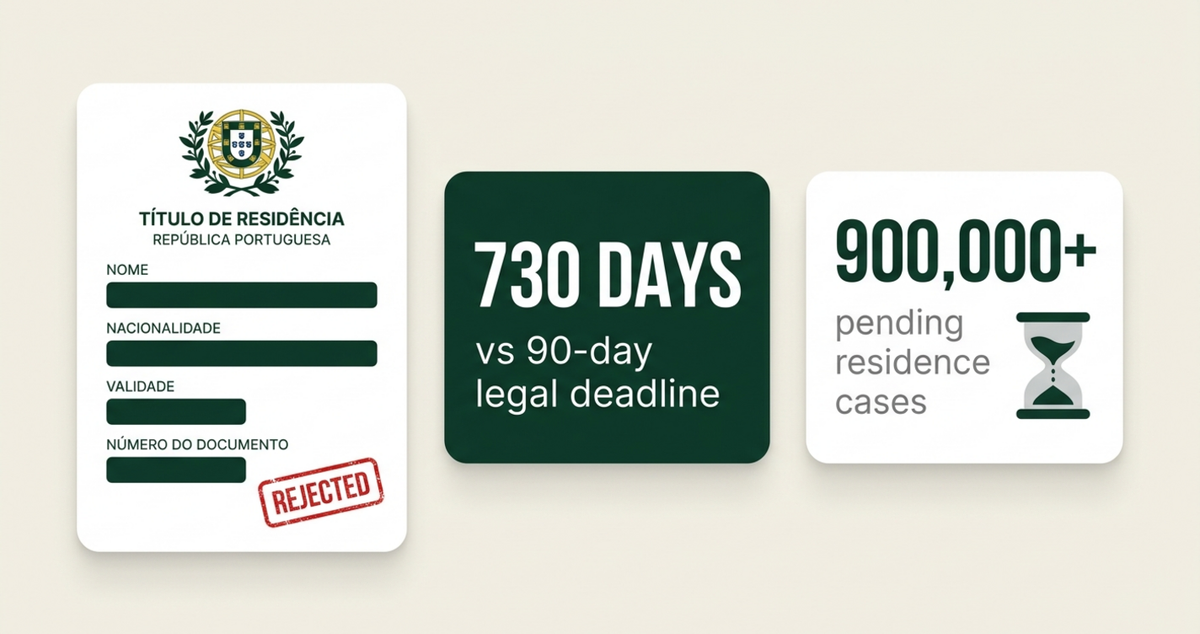
AIMA took two years to decide a family reunification case with a 90-day legal deadline. The delay alone made a compliant 19-year-old deportable.

Sunday at Aeroporto Humberto Delgado in Lisbon.
A 19-year-old high school student lands on a return flight from Ireland. He left days earlier on a school-funded Erasmus trip. He returns to a border agent who checks his documents and orders his immediate detention.
He spends four days in the airport's international zone with only phone contact to his parents. By Wednesday night, he is deported to Brazil.
He committed no crime. The system is the actor here.
AIMA took roughly two years to process a family reunification case that carries a 90-working-day legal deadline. That delay alone erased his eligibility.
Kauê Matos arrived in Portugal in 2024 at age 17, with his parents and younger brother. His parents applied for residency through the manifestação de interesse regime, a mechanism the government abolished in June 2024, mid-process, without resolving the cases already filed under it.
Their plan was to request Kauê's family reunification separately, while he was still a minor.
According to his lawyer, Renato Teixeira, the family filed correctly and on time. AIMA simply did not process the file.
Family reunification applies to minors. When AIMA finally looked at the case, roughly 730 days later, the applicant was 19.
AIMA's backlog did not just delay a residence card. The passage of time converted a compliant case into an ineligible one. Nothing the family did changed. The clock did.
People ask how someone leaves the country without a valid permit but gets caught coming back.
The departure was a school-organized trip to Ireland, part of a group program. Outbound Schengen checks on group travel are often lighter than the individual document verification a third-country national faces on return.
The border agent who intercepted him was enforcing the law as written. The student had no valid residence title, whatever the reason.
According to reporting from Portugal Resident, the enforcing inspector actually tried to delay the removal. He let several Brazil-bound flights leave without Kauê on board, hoping a court would intervene in time. It didn't.
The Lisbon Administrative Circuit Court accepted the family's legal action. The judge gave AIMA seven days to schedule a residence permit appointment, finding no evident grounds to reject the petition.
A court win is not the same as a fast resolution. AIMA has a documented history of missing judicial deadlines.
Reporting from Público in 2024 cited lawyers with multiple cases where AIMA was formally noticed by a court and gave no response at all, on any of them. One lawyer described ten court-noticed cases with zero replies.
Treat the seven-day order as a real step, not a guaranteed outcome.
This is not an isolated incident.
In March 2026, five months before this case made news, a lawyer was already describing people stuck at airports for years, waiting for AIMA to review a case still marked pending.
The scale explains the friction. Roughly 900,000 residence applications were still pending when the current government took office. Separately, 374,000 people sit in the queue for expired-title renewals. More than 130,000 active court cases are now filed against AIMA specifically, just to force a decision.
There is real public pushback on this story. Commenters point out that Brazil enforces its own immigration rules just as strictly on foreigners who overstay.
That's a fair point, and it misses the actual issue. Nobody disputes that Portugal can enforce its border. The problem is a government agency's own delay creating the exact violation its border police then enforce, against a family that filed correctly and never heard back.
AIMA's backlog isn't one problem. It's several, and each carries a different travel risk.
Your title has expired and you're waiting on renewal. You are not authorized to leave and re-enter. Re-entry can be refused even with proof of a pending renewal request.
Your case is still pending and you've never held a valid title. Filing the application does not grant travel rights on its own. A lawsuit against AIMA to force a decision does not grant them either, even after a judge accepts it.
You have a minor dependent whose reunification case is still open. This is the exact risk that ended Kauê Matos's case. If the process runs past their 18th birthday, they can lose eligibility entirely, through no fault of their own. If your child is approaching 18 with a case still open, don't wait for AIMA. Get legal advice before the birthday, not after.
This article explains public reporting and a recurring risk pattern. It is not legal advice for your specific situation.
If any of the three situations above sounds like yours, talk to a registered immigration lawyer or your consulate before booking anything, not after.
If your case is at risk, a vetted immigration expert can walk through your specific timing before you make a decision. Book a free 15-minute discovery call, or a paid consultation with per-session rates. talk to a vetted immigration expert
To see where your own compliance timeline actually stands, run it through the .
If your case has already been approved and you're only waiting on the physical card, that's a different, lower-risk situation, covered here:
Leaving the Schengen area without a valid residence title carries a real risk of being denied re-entry. Outbound checks can miss it. Inbound checks verify your status directly, and that's where this goes wrong. Don't rely on an expired document or a case receipt to travel. Confirm your specific status with a lawyer before booking.
No. A lawsuit can force a judge to set AIMA a deadline. It does not guarantee AIMA meets it, and it does not grant you any right to leave and re-enter Portugal in the meantime. Treat an active case as pending, not resolved, until you have the actual document.
This is the exact mechanism behind this deportation. Family reunification eligibility is tied to age at decision, not age at filing. If AIMA's delay pushes past the 18th birthday, the case can be closed as ineligible, regardless of how correctly or how early it was filed. Get legal advice on protective options before the birthday.
This guide gets updated when the law changes, when this specific case reaches a new legal outcome, or when a reader surfaces something we got wrong.
09 August 2026 (v1.0): First published. Based on cross-referenced reporting on the Kauê Matos case (Observador, JN, DN Brasil, SOL, Portugal Resident, RTP, TVI, Açoriano Oriental, Diário de Coimbra) and current AIMA backlog data.
Worktugal is free: EU tech jobs scored for AI risk, and honest relocation help from someone who has actually done it. Sign up free.
Not sure where your own setup stands? Check your own setup - free, 5 minutes.
Looking for EU tech jobs with AI risk scores? Browse free.