Vercel is hiring across Europe with salaries up to £350,000
Vercel shipped its agentic cloud thesis and is now hiring across Europe. Here is what EU roles pay, where the country restrictions fall, and what Vercel's own internal AI numbers mean for the rest of the market.

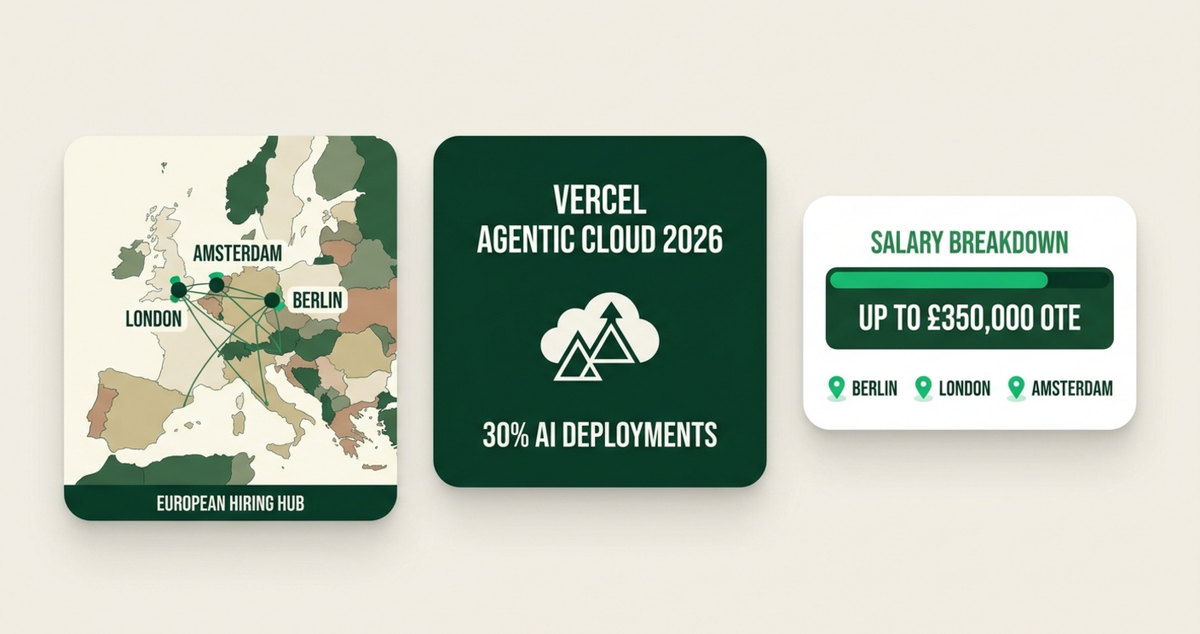
Thirty percent of all deployments on Vercel's platform are now made by AI agents, not human developers. That number grew 1,000 percent in six months. Claude Code alone accounts for 75 percent of those agent-initiated deploys.
Vercel is the company selling agentic infrastructure to the market. It is also the most transparent case study available on what that infrastructure does to the jobs inside your company. Those two facts together make this an unusual spotlight. There is a hiring opportunity here for the right candidates. There is also a warning worth reading before you apply.
What Vercel actually is in 2026
Vercel is the deployment and frontend infrastructure layer behind a significant share of the modern web. It ships Next.js, the dominant React framework. Its AI SDK is downloaded 3.2 million times a week, up from 446,000 a year ago. At a $9.3 billion valuation following a $300 million Series F, the company is building what it calls the agentic cloud: the deployment surface that AI agents write code for, deploy to, and iterate on.
Its 2026 roadmap includes Sandboxes (Firecracker microVMs for running untrusted agent-generated code safely), Fluid Compute (CPU-billed infrastructure for high-concurrency AI workloads), AI Gateway, Workflows, and Queues for durable agent execution. Next.js 16.2, released March 2026, shipped full framework documentation inside the npm package by default because the primary users it was designed for are now AI coding agents, not developers reading docs in a browser.
If you build with AI, you are probably already building on Vercel's stack. Understanding how the company hires matters.
EU hiring footprint: Germany, UK, and the Netherlands
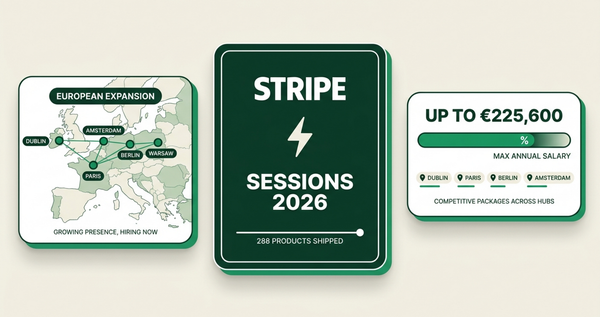
Vercel lists over 60 open roles globally. Roughly a third are explicitly eligible for European candidates. The accepted countries are Germany, the United Kingdom, and the Netherlands. Portugal, France, Spain, Poland, and the rest of the EU are not currently on Vercel's accepted-applicant list for these roles, despite its customer base spanning those markets. The restriction appears to be legal-entity and employer-of-record infrastructure, not market interest.
If you are based outside those three countries, the application form includes an "Other" option, but it is unverified and likely handled case-by-case. Confirm before applying.
Engineering roles open in the EU include Software Engineer positions on the Build Infrastructure, Microfrontends, and Observability teams, available remote from Germany or the UK, or hybrid from Berlin. A DX Engineer role on the AI SDK team is listed as hybrid from Berlin or London. Developer Success Engineer is remote from Germany, the Netherlands, or the UK. Platform Architect EMEA covers the same three countries. These are technical roles with direct product proximity.
The commercial side is London-heavy. Account Executive for v0, Field Marketing Manager DACH and EMEA, Senior Manager Demand Generation EMEA, and Partner Marketing Manager are all available, with most anchored to London or Berlin. The senior GTM roles pay accordingly. Head of Northern Europe Enterprise/Majors is listed at £300,000 to £350,000 OTE. Director of Commercial Sales EMEA is at £300,000 to £330,000 base. These are the ceiling figures; most EU open roles sit well below them.
Current EU openings: vercel.com/careers
What EU roles at Vercel actually pay
Vercel does not publish salary bands on its job postings. All figures come from third-party reporting, and asking for the band on the recruiter screen is the only way to confirm.
UK software engineer total compensation sits at £131,000 to £147,000 based on Levels.fyi data, with the highest reported at £146,800. Glassdoor's aggregated EU figure puts the median at €129,628 for software engineers, which is 15 to 30 percent above Berlin and Germany market averages of €76,000 to €111,000. The premium reflects Vercel's positioning as a prestige employer in the developer-tools space and competition for a global talent pool.
The US equivalent is a different conversation. Staff Software Engineer at Vercel in the US has been reported above $542,000 total compensation. EU roles do not close that gap. The trade-off is real: you get above-market local compensation and a strong employer brand, but not US-level pay. If you are optimising for maximum total comp and can relocate to San Francisco, Vercel's US hiring is the right target. If you are staying in Europe, the EU packages still come out well above the local median.
Equity is part of the compensation structure at Vercel at senior and staff levels. For EU-based hires, the treatment of RSUs can vary by country and by whether Vercel operates via a local entity or employer of record. Clarify this on the offer call, not after you sign.
The interview process
Five rounds, approximately three to five weeks from first contact to offer. Vercel is accessible but not easy, and candidates who skip preparation on practical systems get cut before the final rounds.
Round one is a recruiter screen: background, logistics, role fit. Conversational. Be ready to talk concretely about things you have shipped on Vercel's stack, not what you plan to build. Round two is a proctored online coding assessment, 90 minutes, camera required, no breaks. The problems are practical: rate limiter implementations, sliding window and token bucket trade-offs. Not algorithm trivia.
Round three is a hiring manager conversation about past projects and how you make decisions. Round four is a take-home build assignment. Candidates who do not finish within the time box do not advance. The evaluation is on completeness under constraint, not elegance. Round five is a code review with two engineers discussing your take-home: your implementation choices, how you handle feedback, what you would change.
When it appears, the Architecture Review is the distinctive round. Vercel shows you a realistic piece of its production infrastructure and asks you to critique it: what works, what breaks under load, what you would change and why. This tests judgment with incomplete information. It is the same skill Vercel identifies as the thing agents cannot yet do reliably: owning a production incident from a PR they merged. Green CI is not proof of production safety. The humans at Vercel are being hired precisely to make that call.
What Vercel's own numbers say about AI displacement
Vercel's CPO Tom Occhino disclosed the internal numbers at SaaStr AI Deploy in June 2026. Ninety-six percent of Vercel's marketing content is produced by AI agents. Ninety-three percent of support interactions are handled without a human in the loop. The SDR team was reabsorbed into the broader GTM function because the volume of inbound qualification that justified its existence no longer exists as human work.
These are not projections. They are current operating reality at a company that is 12 to 18 months ahead of most organisations on agent adoption because it builds the tooling everyone else uses.
For candidates targeting the EU roles that are actually open: Forward-Deployed Engineer, Platform Architect EMEA, Developer Success Engineer, and DX Engineer are judgment-heavy, customer-embedded roles. They require the kind of technical credibility and situational reading that agents do not yet have. By Vercel's own framing, these are the roles least likely to be absorbed next.
For anyone in marketing, support, or sales development at a company that has not yet made this transition: the Vercel numbers are the likely destination. Not today, but the direction is clear. The roles are not going away immediately; they are being restructured around the work agents cannot yet do, which means the volume-based functions inside those teams are shrinking first.
Common traps
Applying without checking country eligibility. Vercel's application form asks upfront whether you are in an accepted country. If you are not in Germany, the UK, or the Netherlands, "Other" is unverified. Confirm before investing in the process.
Not finishing the take-home. Candidates who run out of time and submit partial builds get cut. The assessment is designed to test what you produce under a deadline, not what you would ideally build with unlimited time. Scope down if needed; ship something complete.
Ignoring equity structure. Senior roles include equity. The tax treatment of US-company equity for EU-based hires varies significantly. Ask for clarity on vesting, strike price, and secondary sale options. Do not assume it functions identically to RSUs at a locally-incorporated company.
Assuming broad EU remote eligibility. Older listings and third-party aggregators sometimes describe Vercel roles as "fully EU remote." The current accepted-country list for open roles is Germany, UK, and Netherlands. Verify on the Vercel careers page before applying.
Summary
Vercel is hiring 20+ roles across Europe following its $9.3 billion Series F. Active positions are in Germany, the UK, and the Netherlands, spanning engineering, developer experience, and go-to-market functions. UK software engineer compensation runs £131,000 to £147,000; senior GTM roles reach £350,000 OTE. Applications require right to work in Germany, the UK, or the Netherlands.
Full breakdown: https://blog.worktugal.com/vercel-jobs-europe/
Bottom line
Apply to Vercel if you are a senior engineer, developer experience specialist, or technical-commercial hybrid, based in Germany, the UK, or the Netherlands, with experience on Vercel's stack. The interview rewards practical judgment over algorithmic fluency. Compensation is above local market. The roles open in Europe are the judgment-heavy, customer-embedded positions that Vercel's own internal AI adoption has not yet touched.
Skip Vercel if you are based elsewhere in Europe and expecting a straightforward remote offer. The country restriction is explicit and structural, not a policy that changes on request.
Frequently asked questions
Can I work a Vercel EU role from Portugal?
Not for current open roles. Vercel's accepted-country list for European applications is Germany, the UK, and the Netherlands. Portugal is not currently included. An "Other" option exists on the application form but its handling is unverified. Confirm eligibility with the recruiter before investing time in the process.
Does Vercel sponsor visas for EU roles?
Vercel's EU job listings do not specify visa sponsorship. Roles in Germany and the UK require the right to work. Confirm sponsorship status on the recruiter screen. Do not assume it is offered based on the role description alone.
What does the Vercel interview process look like?
Five rounds over three to five weeks: recruiter screen, proctored coding assessment (90 minutes, camera required), hiring manager conversation, take-home build assignment, and a code review with two engineers on your take-home. Some tracks include an Architecture Review where you critique a real piece of Vercel's production infrastructure. Average difficulty on Glassdoor, average time to offer 25 days.
What is the AI displacement risk for Vercel EU roles?
Medium-Low for the roles currently open in Europe. Forward-Deployed Engineer, Platform Architect, Developer Success Engineer, and DX Engineer are judgment-heavy and customer-embedded. These are the type of work Vercel's CPO explicitly says agents cannot yet own reliably. High risk for marketing, support, and SDR-adjacent functions: Vercel has already automated 96 percent of marketing content, 93 percent of support interactions, and reabsorbed its SDR team. These numbers are a leading indicator for what companies at earlier stages of agent adoption will experience in the next two years.
Every EU tech job on Worktugal comes scored for AI displacement risk, not just salary and location. See what's open.
Article updates
This article is updated when Vercel changes its EU hiring footprint, compensation data is revised, or significant product announcements affect the displacement risk assessment.
14 June 2026 (v1.0): First published. Role data from vercel.com/careers (scraped June 2026) and Parallel AI deep research (June 2026). Salary from Levels.fyi and Glassdoor self-reported data. AI displacement figures from Vercel CPO Tom Occhino at SaaStr AI Deploy, June 2026.