Datadog hiring in Paris with salaries up to €170,000
Datadog crossed $1 billion in quarterly revenue and Paris is where the AI products that got them there are built. Here is what Senior LLM Engineer roles pay, what the interview looks like, and the one thing most candidates miss.

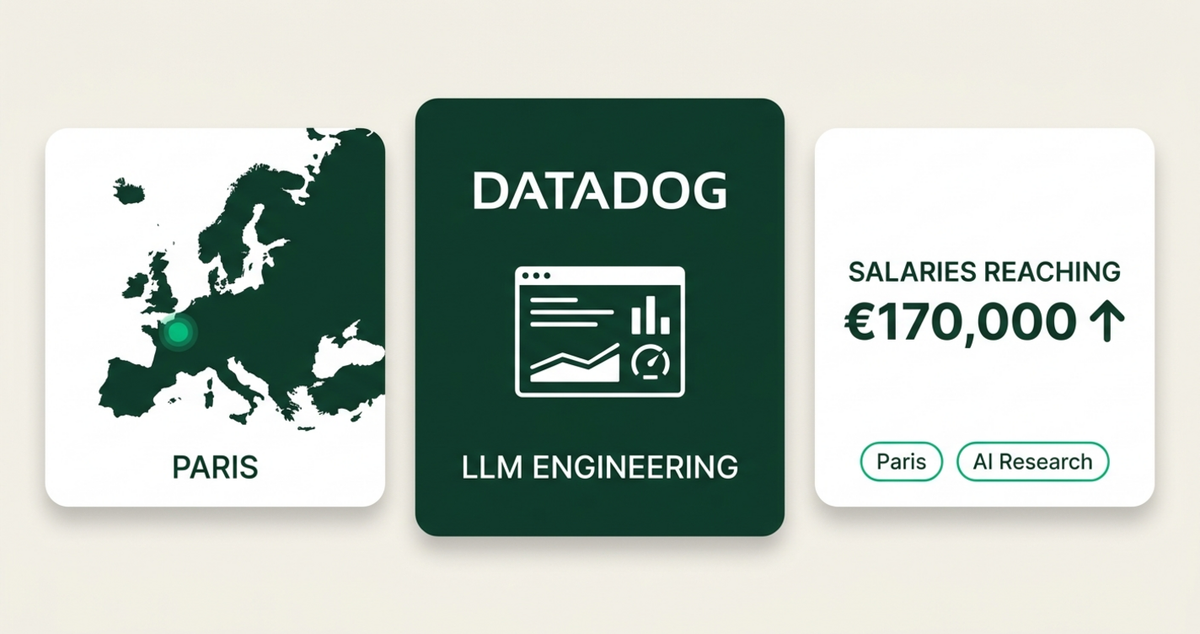
Datadog just reported its first billion-dollar quarter. The Paris office is where it built the AI products that got it there, and they are still hiring.
The company posted $1.006 billion in Q1 2026 revenue, a 32% increase on the same period last year. That growth came primarily from AI observability products: a suite of tools that monitor LLM applications, track GPU costs, and investigate security incidents autonomously. Most of that product work happens in Paris.
Right now, 35 of Datadog's 87 open European roles are in Paris. The Senior LLM Engineer position is among them.
What the role pays
Senior engineers in Paris earn between €120,000 and €170,000 in total compensation. The median sits around €147,000 to €150,000: a base salary in the €96,000 to €119,000 range plus RSUs worth €44,000 to €51,000 annually on a four-year vesting schedule.
For context, the national median for software engineers in France is roughly €57,000 to €75,000 total compensation. Outside Paris, €100,000 is essentially unavailable. Datadog pays two to three times the French market rate. It is the highest-paying employer in France with any real engineering headcount.
Annual performance bonuses run 10 to 15% of base. The ESPP lets employees buy shares at a 15% discount. In France specifically, the benefits include mental health support and daycare partnerships.
What you are actually building
The Paris office is not a satellite. It houses the Datadog AI Research Lab, known internally as DAIR, which runs about 20 researchers across Paris and New York in partnership with French universities through the CIFRE programme.
DAIR's current flagship is Toto 2.0, a family of open-weights time series foundation models for observability. Five sizes from 4 million to 2.5 billion parameters, trained on Datadog's internal telemetry data, built for anomaly detection and capacity planning at scale. This is not prompt engineering layered on top of a commercial model. It is original model research with production deployment across Datadog's 4,550 enterprise customers.
Beyond research, the Paris team ships product. Bits AI Security Analyst, which automates cloud security investigations, went generally available in Q1 2026. So did LLM Observability, which traces LLM application calls, tracks token costs, and flags degraded responses. GPU Monitoring shipped the same quarter. The engineers writing these products work out of this office.
The hybrid requirement
Datadog is not remote-friendly. The company expects corporate employees in the office three days a week. This is enforced, not advisory. Candidates who want to work from Lisbon or anywhere outside Paris should not apply for this role.
If you are willing to be in Paris three days a week, the tradeoff is straightforward: lower living costs than London or Amsterdam, higher salaries than anywhere else in France, and work on AI infrastructure that runs at a scale most research environments cannot match.
Visa and relocation
Datadog sponsors visas through the French Tech Visa programme. Processing takes two to four weeks, which is fast for a European work permit. The resulting Passeport Talent residence permit is valid for up to four years and covers both work and residency.
Relocation support is available for eligible hires moving to Paris, though the exact package is negotiated during the offer stage rather than published. The EU data region launched in Germany means Datadog is also expanding its European compliance infrastructure, which typically signals sustained investment in EU headcount.
How to prepare for the interview
The process has four stages. First, a HackerRank online assessment. Then an HR call. Then two technical rounds: live coding followed by system design. Questions focus on real observability problems at scale, things like log indexing under high write throughput or anomaly detection in distributed traces.
The bar is high and consistent. Senior and staff-level roles are selective. Candidates who review Datadog's open-source repositories (dd-trace-py, the Datadog Agent in Go) before the system design round report better outcomes. The company expects you to understand the domain, not just the algorithms.
Verify current openings directly: careers.datadoghq.com/emea
Common traps
Applying without Paris availability. The role requires three days on-site. If your cover letter mentions remote work or a different city, you will not advance.
Underestimating RSU importance. Base salaries in Paris sit below equivalent London roles. The total compensation figure depends on equity appreciation. Ask the recruiter about annual refresher grants and the company's secondary sales policy before signing.
Skipping the system design prep. Datadog interviews for domain knowledge, not just algorithmic fluency. Candidates who have not engaged with observability problems in practice (distributed tracing, metrics pipelines, log aggregation) struggle in the technical rounds.
Ignoring French employment terms. RSUs in France may be structured as actions gratuites (free shares) with specific tax treatment. Ask HR whether your grant uses the standard RSU structure or the French-specific scheme, as the tax implications differ.
Bottom line
Apply if you want to build AI systems at real scale, are willing to relocate to Paris, and can negotiate aggressively on your initial RSU grant. The salary is the best available in France, the AI research work is credible, and the company is profitable and growing fast. Avoid if you need full remote flexibility or expect a London-equivalent base salary without the equity component.
Frequently asked questions
Can I work this role remotely from within the EU? No. Datadog requires three days on-site in Paris. Remote from any EU country is not supported for this role. You need to be in Paris.
Do they sponsor visas? Yes. Datadog uses the French Tech Visa programme. Processing takes two to four weeks. The Passeport Talent permit covers both work and residency for up to four years.
What is the interview process? Four stages: HackerRank assessment, HR call, live coding round, system design round. Senior roles may include an additional architecture discussion. Expect questions grounded in observability problems, not generic LeetCode.
Is the salary negotiable? Yes. Base salaries in Paris trail London benchmarks. The real upside is in the RSU grant and annual refresher policy. Negotiate those specifically rather than base salary, where Datadog's Paris bands are fixed.
Get the Signal every Monday
Article updates: 02 June 2026 (v1.0). First published.
Every EU tech job on Worktugal comes scored for AI displacement risk, not just salary and location. See what's open.
Related: Portugal Tax Residency Guide