Databricks hiring across Europe with salaries up to £263,000

Every week I curate EU tech roles for Worktugal's job board. Databricks keeps appearing at the top of the salary data.
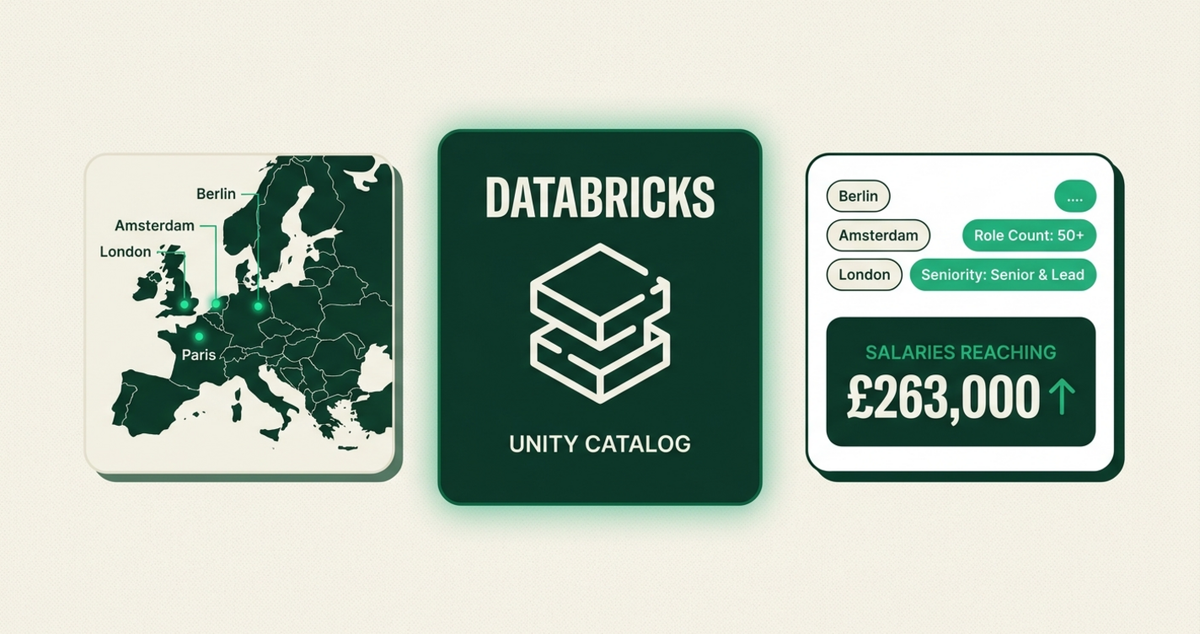
London staff engineers can reach £263,804 in total compensation, roughly €308,000. Berlin software engineers average €132,820. The company is actively building engineering teams in Amsterdam and Munich too. If you work in data infrastructure, ML platforms, or backend systems, this is one of the highest-paying engineering roles available in Europe right now.
Here is what the expansion actually looks like for someone based in the EU.
Where Databricks is hiring in Europe
Databricks has four confirmed engineering hubs in the EU with active hiring as of May 2026:
- London: largest EU office. Staff and senior backend engineers, Scala, Spark, Go, ML Platform. Total comp up to £263,804 at the 90th percentile.
- Berlin: the growth hub for core infrastructure engineering. Senior Staff Software Engineer on Delta Lake, Staff Backend. Scala, Kubernetes, Spark focus.
- Amsterdam: Senior Software Engineer, Backend roles. Smaller office, growing.
- Munich: Field Engineering focused on digital natives and scale-ups. More customer-facing than pure infrastructure.
These are not satellite offices. Each hub runs meaningful engineering work on core Databricks products: Delta Lake, Unity Catalog, MLflow, and the Lakehouse platform itself.
What Databricks pays in Europe
The numbers are in GBP, not EUR. If you are comparing across EU markets, apply the exchange rate (approximately £1 = €1.17):
- London Staff Engineer: £123,000 average base salary. With bonus and equity, total compensation reaches up to £263,804 at the 90th percentile. That works out to roughly €308,000 total comp at current rates.
- Berlin Software Engineer: €132,820 median total compensation. Berlin offers lower comp than London but significantly lower cost of living.
- London Databricks Engineer (general): £58,710 average base. This is a wider market figure and likely reflects more junior or non-engineering roles.
The equity component is significant. Databricks is private, so the value depends on secondary market prices and the company's IPO timeline. Ask about liquidity windows and strike prices before signing.
Why Databricks is hiring now
Three things are happening simultaneously.
First, Databricks is shifting from a workspace-centric model to an account-centric platform. The Azure Databricks Standard tier was retired in April 2026. This architectural change requires more engineers to unify the platform across customer accounts.
Second, the company is investing heavily in Europe. In April 2026, Databricks announced a partnership with STATION F in Paris to accelerate AI adoption for European founders. This is not just a PR move. It signals a real commitment to the EU as a growth market.
Third, their open-source strategy is paying off. Delta Lake, MLflow, and Unity Catalog are widely adopted across EU enterprises. European companies that use these tools prefer hiring engineers who already know them. Databricks needs EU-based engineers who understand the local market and can support these customers.
How Databricks compares to Snowflake for your career
If you are an EU data engineer deciding between these two, the choice matters:
- Databricks wins for AI/ML workloads. If you want to work on ML pipelines, LLM infrastructure, or data science platforms, Databricks is the stronger bet. Their end-to-end ML capabilities are ahead of Snowflake.
- Snowflake wins for SQL performance. If your expertise is in pure SQL analytics, data warehousing, and business intelligence, Snowflake's out-of-box query performance is better.
- Open source vs proprietary. Databricks engineers contribute to and build on open-source projects (Delta Lake, MLflow, Unity Catalog). Snowflake engineers work on a proprietary platform. This affects what your CV looks like in 3 years.
The trade-offs
Databricks pays well, but the engineering culture has a known cost. Internal employee profiles consistently highlight the challenge of on-call fatigue. The platform serves critical infrastructure for some of the world's largest companies, and incidents happen. Teams are actively working on improving alert processes and reducing burnout, but the operational load is real.
Most roles require physical presence in London, Berlin, Amsterdam, or Munich. Visa sponsorship is available for senior roles but not guaranteed. Confirm this in your first recruiter conversation.
Common traps
- Assuming equity is liquid. Databricks is private. Your RSUs have no public market. Ask about tender offers and the company's IPO timeline.
- Comparing London comp to Berlin comp directly. The numbers are in different currencies and reflect different cost structures. £263K in London goes much less far than €132K in Berlin.
- Applying without Scala or Spark experience. Most backend roles at Databricks expect Scala, Spark, or Go. Python-only engineers will have a harder path.
- Underestimating the interview bar. Databricks runs a rigorous technical process. Expect system design, coding, and multiple rounds over 2-4 weeks.
Frequently asked questions
Can I work for Databricks from Portugal?
Databricks does not have an office in Portugal and does not list Portugal as an eligible remote location for most engineering roles. Most positions require presence in London, Berlin, Amsterdam, or Munich.
Does Databricks sponsor visas in Europe?
Yes, for senior and staff-level roles in London and Berlin. Not guaranteed. Confirm in the first screening call.
What is the interview process like?
Coding assessments in Scala, Python, or Spark, system design rounds, and behavioral interviews. Typically 3-5 rounds over 2-4 weeks.
Does Databricks pay well in Europe compared to other AI companies?
Yes. London staff engineers can reach £263,804 total comp (90th percentile). Berlin software engineers median is €132,820. Competitive with Anthropic and Mistral, though base salaries are lower than US equivalents.
Which EU cities does Databricks have offices in?
London, Berlin, Amsterdam, and Munich for engineering. Paris through the STATION F partnership, focused on ecosystem development.
Bottom line
Apply to Databricks if you are a senior or staff-level engineer who wants to work on core data infrastructure at scale and is willing to relocate to London, Berlin, or Amsterdam. The open-source contributions will compound on your CV. Skip it if you need remote work from Southern Europe or cannot tolerate on-call rotation.
View open Databricks roles in Europe: databricks.com/careers
Every EU tech job on Worktugal comes scored for AI displacement risk, not just salary and location. See what's open.