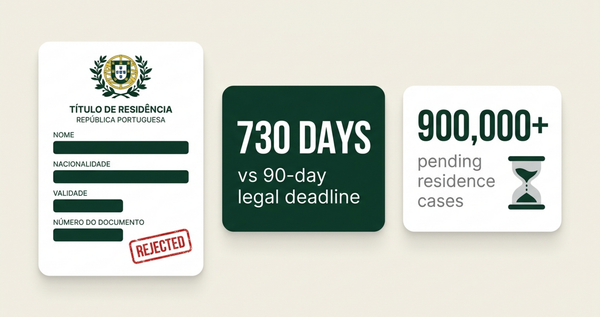
Portugal's new citizenship law: who it saves and who it traps
The citizenship law was signed. But the part everyone is panicking about is wrong. Here's what actually changed and who it protects.

President Seguro signed the Nationality Law on May 3. The 5-year path to citizenship is gone. Here's what actually matters.
Non-EU and non-CPLP nationals now need 10 years of legal residency. EU citizens and CPLP nationals need 7.
That part is real. It will hurt.
But the law is not in force yet. Signed. Not published in Diário da República. It takes effect the day after publication. That window matters if you are close to filing.
The thing tearing through immigration forums right now is the clock. Specifically whether AIMA delays still count toward your citizenship timeline. The answer is not yes or no. It depends on when you filed, and whether your application was decided before the law took effect.
Two people, two different outcomes
Meet Maria. She submitted her residency application in 2022. AIMA took 2 years to issue her card. Her citizenship application was decided in early 2026. Under the new law, Maria is fully protected. Her clock ran from her 2022 application date. The 2-year AIMA wait counts. The Constitutional Court ruling covers her.
Meet David. He submitted his residency application in late 2023. AIMA issued his card in early 2025. He has not filed for citizenship yet. He planned to do it next year. Under the new law, David's clock starts from the date his card was issued: 2025. Not 2023. The 1.5 years he spent waiting for AIMA do not count. He now needs 10 years from card issue, not the 7 he thought he had left from his original application.
This is the split. It is the most important thing to understand about this law, and the part most coverage gets wrong.
The Constitutional Court ruling: what it actually did
In December 2025, the Constitutional Court reviewed the previous version of this law and issued Acórdão n.º 1133/2025. The ruling was not a blanket rejection. It was a surgical strike.
The Court struck down transitional rules that would have applied the new card-issue-date method to applications that were already decided. If AIMA had already approved or denied your citizenship application before the law took effect, the new clock cannot be applied retroactively to your case.
The Court did not strike down the prospective change. For applications filed or decided after the new law takes effect, the clock starts from the date the residence card was physically issued. Not the date you submitted the application.
The President addressed this in his May 3 signing statement. His words: "a contagem dos prazos legalmente fixados para a obtenção de nacionalidade não ser afetada pela morosidade do Estado." The counting of deadlines should not be affected by state slowness. But this is presidential guidance, not a binding clause. The binding protection only covers decided applications. And only because the Constitutional Court forced it.
| Your situation | Clock starts from | AIMA delays count? |
| Application decided before new law takes effect | Application date | Yes, protected by TC |
| Application filed before law, not yet decided | Application date | Yes, protected by TC |
| No application filed yet, filing after law takes effect | Card issue date | No. AIMA delays penalize you |
What changed
The residency period for citizenship doubled. Non-EU and non-CPLP nationals went from 5 years to 10. EU and CPLP nationals went from 5 to 7.
The Sephardic Jewish descendant route is eliminated entirely. No new applications. The path in place since 2015 is gone.
Children born in Portugal to foreign parents now need at least one parent with 5 years of legal residency. The old rule required 1 year.
What did not change
This law does not touch your right to be here.
Permanent residency is still 5 years. You can apply for PR after 5 years of legal residence. It locks in your right to live, work, and study in Portugal indefinitely.
Your current visa. D7, D8, Golden Visa. Still valid and renewable as before. Schengen travel under your current card is unchanged.
One thing to know: PR travel in Schengen is limited to 90 days in any 180 outside Portugal. Citizenship gives you full EU freedom of movement. PR gives you Portugal.
What the President's reservations actually mean
Seguro signed. He was not quiet about his concerns.
He said pending processes must not be affected. He said the clock should not be penalized by state slowness. He said the law should have had broader political consensus, not reflect "marcas ideológicas do momento." He said protection of children born in Portugal must remain a priority.
These are presidential signals. They are not legally binding. The binding protection comes from the Constitutional Court. And it only covers applications that were already decided or pending before the law takes effect.
What to do based on your situation
Your citizenship application was already decided: you are protected. The new law does not apply retroactively to your case. Do not withdraw anything. Do not refile.
Your application is still pending: you are protected while it processes. Your clock runs from application date. AIMA delays count. Do not withdraw.
Close to 5 years but have not filed: talk to a lawyer this week. Before Diário da República publication. Filing before the law takes effect may protect your timeline. The window is measured in days.
For cases where the clock matters, a vetted immigration expert can check whether your application dates protect you under the new rules. Free 15-minute discovery call, paid consultations by the session. talk to a vetted immigration expert
Years away from applying: when you eventually file, the clock starts from card issue date. Every month AIMA delays issuing or renewing your card is a month that does not count toward citizenship. Focus on Permanent Residency at year 5. Check your compliance now. Gaps that were annoying under a 5-year timeline are dangerous under 10.
Golden Visa investor: your path is now 10 years. Your investment and legal residency remain valid.
Frequently asked questions
Does the new law cancel my residency permit?
No. D7, D8, Golden Visa, TRC. All unaffected. You can still live, work, and renew.
I have lived in Portugal for 4 years. Do I now need 10 years?
If you have not filed a citizenship application yet, yes. Your 4 years still count. You need 6 more (non-EU) or 2 more (EU/CPLP).
When does my citizenship clock actually start?
It depends on when your application was decided relative to the new law. See the table above.
What if AIMA took 2 years to issue my card?
If your citizenship application was already decided, those 2 years count. If you have not filed yet and the new law takes effect, those 2 years will not count when you eventually apply.
My citizenship application is already submitted. Am I protected?
Yes. Applications already filed and decided before the law takes effect are protected under the old 5-year rule.
Can I still get Permanent Residency after 5 years?
Yes. PR remains at 5 years. AIMA appointment backlogs may delay when you can file, but the eligibility is unchanged.
Does this affect children born in Portugal?
Yes. A child born in Portugal to foreign parents now requires 5 years of legal parental residency before applying for citizenship. The old 1-year rule is gone.
Has the law been published in Diário da República yet?
No. As of May 8, 2026. Takes effect the day after DR publication.
What countries are in CPLP?
Brazil, Angola, Mozambique, Cape Verde, Guinea-Bissau, São Tomé and Príncipe, Timor-Leste, and Equatorial Guinea. Nationals get the 7-year timeline instead of 10.
Where do you actually stand?
The legal distinction is narrow. The practical difference is everything. Whether you are Maria or David depends on a single date: when your application was decided relative to the law taking effect.
The diagnostic data from 57 people who ran the Worktugal tool shows 50% are missing NISS. 31% have not declared tax residency. 46% have not booked AIMA. Gaps like these were inconvenient under a 5-year timeline. Under 10 years of exposure, and with a clock that starts from card issue date for new applicants, they are expensive.
This article reflects the situation as of May 8, 2026. Decreto n.º 48/XVII promulgated May 3 but not yet published in Diário da República. Takes effect day after DR publication. For educational purposes only. Consult a certified Portuguese immigration lawyer.
Sources: Presidência da República (May 3, 2026), Constitutional Court Acórdão n.º 1133/2025 (December 2025), Decreto n.º 48/XVII.
Background: this article updates our April 2026 coverage of the law passing Parliament.
Worktugal is free: EU tech jobs scored for AI risk, and honest relocation help from someone who has actually done it. Sign up free.
Not sure where your own setup stands? Check your own setup - free, 5 minutes.
Looking for EU tech jobs with AI risk scores? Browse free.